Being found on ChatGPT: What we learnt from our GEO experiment
TL;DR We tested GEO (Generative Engine Optimisation) on our own platform, Congresagenda.nl. We added structured data, llms.txt and AI-generated content, and tracked the results. What we found: AI-driven traffic is growing, our Google rankings remained strong and we’re appearing in ChatGPT — but often in response to very different queries than we’d anticipated. The lesson: don’t optimise for individual queries, but write for the moments when people are searching (the so-called ‘category entry points’) and be a comprehensive, reliable source. Below is our approach, the figures and what this means for DMOs and CMOs.

Imagine this: a professional is looking for an inspiring conference. A visitor is planning a weekend in your city. In the past, they’d open Google and choose from ten blue links. Now they ask ChatGPT, Gemini, Ask Maps or Perplexity. And they get a single answer back. Not a list, but a brief tip with a few names.
And that’s where the problem lies. Your museum, festival or events calendar does exist — but if it’s missing from that single AI answer, the visitor won’t see it. The insidious thing is: you don’t notice it. No error message, no drop in numbers that you’d spot straight away. Just visitors you’re quietly missing out on. So the question for every DMO, CMO and cultural organisation is simple: are you in that result, or not?
We didn’t just want to understand this, we wanted to experience it for ourselves. That’s why we tested GEO on our own platform: Congresagenda.nl. This blog isn’t theory, nor is it a sales pitch. It’s about sharing knowledge: what we did, what it achieved, and what we learnt from it. We’ve written previously about the shift itself: When search splits in two: how DMOs remain relevant and trustworthy in the AI era. First, a brief explanation:
What is GEO?
Alongside SEO (being found in search engines), a new discipline is emerging: GEO — Generative Engine Optimisation. In other words: ensuring that AI models such as ChatGPT, Perplexity and Google’s AI summaries understand, trust and pass on your information in their responses. The difference is important. With SEO, you want to rank highly in a list. With GEO, you want to be the answer.
What an expert has to say about it
More and more people are noticing the shift we’re seeing in practice. Author and speaker Martin van Kranenburg wrote a book about it, titled From SEO to GEO. He sums it up succinctly:
“The era of the ten blue links is drawing to a close. We’re moving from a search engine era to an answer engine era. You’re no longer found: you’re chosen. Anyone who isn’t part of that simply doesn’t exist at the moment of decision.”
In an interview with Managementboek, he goes on to say: a language model doesn’t look at what you say about yourself, but at what others confirm — reviews, articles and comparisons. That makes it confrontational, but also fair.
His advice on how to get started ties in seamlessly with our approach: carry out a baseline assessment. Open ChatGPT in a temporary chat (so don’t log in, otherwise the model will already recognise you), ask your ten most important customer questions and see if your brand appears in the answer. If not — why not? And he calls his rule of thumb for strong content the AUB’tje: be Up-to-date, Unique and Reliable. Exactly what a language model needs to dare to mention you.
Not keywords, but people
So how do you create content that’s useful to both an AI and a human? SEO and GEO specialist Chantal Smink turns the approach on its head. She no longer starts with keywords, but with people: create content that genuinely helps and answers what your customer is actually looking for (AKA Helpful content).
To do this, she uses the QPAFFCGMIM model: ten categories to truly understand your customer — Questions, Problems, Alternatives, Frustrations, Fears, Concerns, Goals, Myths, Interests and Misunderstandings. Not just a list of keywords, but the layers, intentions and motivations behind your reader’s behaviour. If you understand these, you’ll create content that naturally becomes more relevant — for people, search engines and AI alike. She developed this approach in her book The Content Canon.
This blog has been created in exactly this way. We didn’t start with keywords, but with the questions and concerns you have as a destination marketing professional — you’ll find some of them reflected in the frequently asked questions further down.
What we actually did
No theory, just real steps taken on Congresagenda.nl, our testing ground — a place where we carry out real-world testing:
- We examined intentions. Using the QPAFFCGMIM model , we identified the questions a professional asks when researching a conference, workshop or continuing professional development course. Not just keywords, but the actual question behind them. We didn’t conduct the interviews ourselves, but generated them based on a number of job profiles.
- Set up our AI writing assistant. We created a special prompt to ensure that every conference description is accurate for people, for search engines and for AI models.
- Added structured data to all event pages. These are fixed fields — date, location, type, target audience — that computers can understand straight away, without having to parse the text.
- llms.txt and llms-full.txt added. This isn’t a proven GEO technique — it’s a matter of debate. But it’s easy to implement and may contribute slightly to discoverability for bots. It’s a minor effort, so we went ahead and did it.
- Events rewritten in multiple languages using the AI assistant — for SEO, for GEO, and above all for multilingual professionals who really want to learn something.
- Bots tracked in the server logs. There you can see which crawlers are visiting, such as GPTBot, OAI-SearchBot and ChatGPT-User. OpenAI documents these bots itself (overview here). This is information that standard analytics often hides.
What it achieved
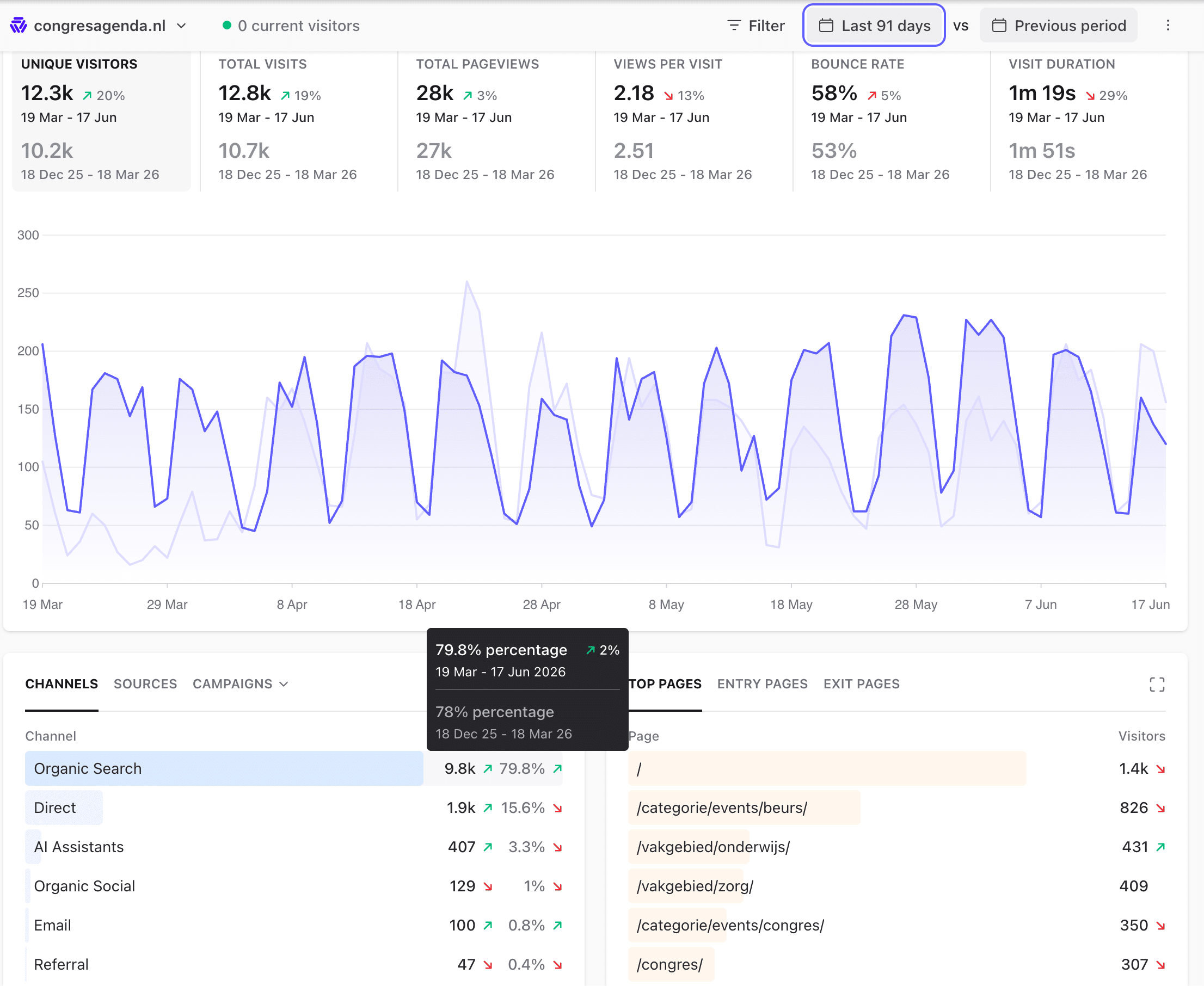 The figures for the last three months (19 March – 17 June 2026):
- 12,300 unique visitors — an increase of 20%.
- Organic search remained strong: 79.8% of traffic. Our strong rankings and search terms held up. GEO therefore did not come at the expense of traditional SEO.
- AI Assistants is a separate, growing channel: 3.3% of traffic (407 visits). People are now arriving via ChatGPT and similar tools.
- Almost 1 in 6 visitors clicks through to the organiser (CTR 17.6%).
- Using GEO tools such as Rankshift and Promptwatch, as well as our own research, we saw that we do indeed appear in AI responses.
To be honest: not every metric improved. Session duration got shorter and the bounce rate was slightly higher. More visitors also means more people who have a quick look and leave again. That’s part of testing — you measure everything, even the disappointing results.
The surprising lesson
This is the most important thing we learnt, and something no GEO checklist will ever tell you:
People are finding us — but not for the questions we’d thought of beforehand.
We had a list of questions in mind. In practice, Congresagenda.nl turned up in response to completely different questions. AI -models combine information in ways you cannot fully predict or control. The conclusion? You cannot optimise for every single question individually. What does work: ensuring you are a comprehensive, reliable and well-structured source. Then you’ll be picked up — even for questions you hadn’t thought of yourself.
For now, write down: ‘category entry points’
There’s a marketing concept that explains our observation perfectly: category entry points (CEPs). These are the moments when someone thinks of a category and brands spring to mind. The idea comes from the book How Brands Grow by Byron Sharp and revolves around mental availability: are you remembered the moment the need arises?
Think about this: it’s the weekend, it’s raining, and you want to do something with the children. At that moment, a museum or attraction springs to mind — or it doesn’t. That moment is a CEP.
In AI search, those moments suddenly become visible. People describe their entire situation in their own words. And behind a single situation lie dozens of different questions. If you write your content around the moment rather than around a single keyword, you’ll be found for all those variations — even the ones you’d never have thought of. That’s exactly what we saw happening.
SEO platform Semrush tested this and found the same thing: articles built around a specific moment were cited in AI responses for months on end. Articles on a general topic dropped off the radar after a few weeks (read their research).
For a DMO or cultural organisation, this means: think in terms of moments, not keywords. For example:
- “It’s raining this weekend — what can I do with the children in [city]?”
- “I’m looking for a conference to keep up to date in my field.”
- “We want to book an inspiring day out with the team.”
How do you get started? Sit down with your team — editorial, customer service, … and any partners — and write down twenty real-life moments when someone might need what you offer. See which ones you’re already covering well and where there are gaps. Then write the page you’d want to find yourself if you typed that moment into ChatGPT.
What this means for DMOs and cultural organisations
Apply our experience to your agenda:
- Structure trumps flowery language. Ensure that every event is recorded in your data in a complete and unambiguous way: date, location, type, target audience. AI understands facts better than full sentences.
- You are the reliable source of information about your own destination. But that information must be up to date and complete online, written in a way that computers can easily read.
- Optimise for the whole, not for a single query. You can’t guess which query a visitor will type. A rich, accurate calendar will appear more often — automatically.
And what about balancing this with your budget? You don’t have to choose between adverts, SEO and GEO — they reinforce each other. Advertisements deliver traffic quickly, but stop as soon as your budget runs out. SEO builds traffic that lasts, organically and without any cost per click. The same – distinctive, more up-to-date, reliable and therefore better – content that you create for SEO often works for GEO as well. One effort, two channels.
Frequently Asked Questions
1. What is the difference between SEO and GEO? SEO ensures you rank highly in Google or Bing’s search results — a list of links. GEO ensures that AI models such as ChatGPT use your information in their responses. With SEO, you’re on the list; with GEO, you are the answer. They reinforce each other: the same clear, comprehensive content helps with both.
2. My events are already online — so why don’t they appear in ChatGPT? Being online isn’t the same as being found by AI. Models primarily pick up information that is clearly structured, comprehensive and reliable. If your event is listed as a single block of text without clear fields (date, location, type), it’s less likely that an AI will pick it up and pass it on. Structure and completeness make all the difference here.
3. Do I have to choose between advertising, SEO and GEO? No. Think of them as three channels that complement each other. Adverts are quick but temporary. SEO builds up traffic slowly but sustainably.
4. What happens if I don’t do anything with GEO right now? In the short term, probably nothing very noticeable. But more and more people are searching via AI. Anyone who isn’t featured in the results will gradually become invisible — without even realising it, because you won’t see a drop in something you never had in the first place. Starting early gives you a head start and time to learn.
5. Does GEO require a lot of extra work or budget? In our experiment, it wasn’t as much as we’d expected. The biggest gains came from things you’d want to do anyway: comprehensive, well-written event information and a clear structure. Technical additions such as structured data and llms.txt are relatively minor tasks. You’re building on your existing SEO, not alongside it.
6. Does GEO come at the expense of my Google traffic? Not for us. During the experiment, organic search continued to account for 79.8% of traffic and our rankings held steady. However, several blogs have reported that traffic from various websites has dropped significantly. We were worried about this, but fortunately it wasn’t as bad as we’d feared. The GEO adjustments — improved structure and content — may well have actually helped traditional SEO too. So you don’t have to choose.
7. How do I know if my organisation appears in AI responses? There are three ways. Ask ChatGPT and Perplexity questions yourself and see if you’re mentioned. Use GEO tools such as Rankshift or Promptwatch that track this. And check your server logs to see which AI bots (such as GPTBot or OAI-SearchBot) are visiting your site — you often won’t see this in standard analytics.
About Event Connectors
Event Connectors is building our SaaS tools packed with events, venues and routes for destination and city marketing. We help DMOs and cultural organisations to structure their offerings in such a way that they can be found — both on Google and in the new search. Congresagenda.nl is our testing ground and proof that this works.
Curious to find out what GEO can do for your events calendar? Get in touch with us — we’d be delighted to show you what we see.
Event Connectors helps marketers in the destinations, tourism, culture and leisure sectors to remain visible in a world where search is changing.
(AI) Transparency:
This blog was drafted using AI and subsequently rewritten and updated by the author with figures and additional information. This blog also contains affiliate links to books by Martin van Kranenburg and Chantal Smink. If you make a purchase via one of these links, we may receive a small commission — at no extra cost to you. We only link to work that we ourselves find valuable.
Sources:
- ‘Don’t ask about Google rankings, but whether you appear in AI answers’ – Martin van Kranenburg
- ‘We need to move away from traffic metrics’ – Chantal Smink
- Why Category entry points belong in every AI search strategy – Semrush
- How do I make AI search visible using server logs
